From Canada to the Coast
When Elissa left Canada to pursue graduate studies at the University of Washington, she wasn’t just looking for a new place to study. She was looking for the right environment to grow as a researcher. Originally from Lebanon, she later moved to Canada, where she completed both her undergraduate and master’s studies. It was during that time that she developed a strong interest in how species evolve to adapt to changes in their environment, an interest that would eventually shape her academic path.
Drawn to UW for its research strengths and its proximity to the diverse ecosystems of the Pacific Northwest, Elissa found an ideal setting to continue exploring these questions.
What brought me to UW was the research that's going on here.
Being surrounded by coastal environments, wetlands, and urban landscapes has allowed her to engage directly with the systems she studies, connecting theory with hands-on research in a meaningful way. She joined the research group of Dr. Andrea Durant in the Department of Biology.
Researching Adaptation in Changing Environments
At the center of Elissa’s work is a fascinating question: how do some mosquitoes adapt to environments that would typically be inhospitable to them?
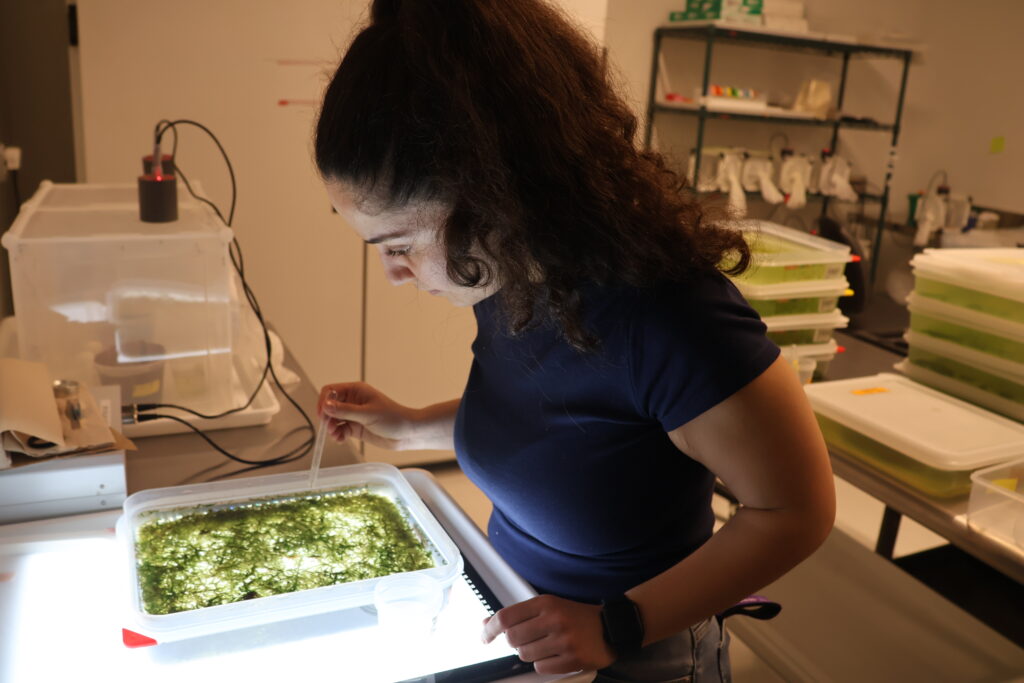
She studies saline-tolerant mosquito larvae, part of a small subset of species capable of surviving in brackish or ocean water. While most mosquito species rely on freshwater, these species have evolved specialized mechanisms to regulate salt and maintain balance in harsher environments. Elissa’s research focuses on a newly evolved salt gland that allows these mosquitoes to actively secrete salt and survive where others cannot.
“In terms of an evolutionary perspective, saline tolerance is becoming more common,” she explains. “It’s important to understand this mechanism and how to mitigate mosquitoes in coastal areas.”
Much of her work involves closely observing how salt moves through the mosquito’s body by tracing how ions are transported, processed, and expelled. This often means spending long hours at the microscope, examining gland structures and watching how these tiny systems function in real time. One of the more demanding aspects of her work has been maintaining a colony of Aedes togoi mosquitoes in UW’s insectary. These mosquitoes are highly sensitive to environmental conditions including light cycles, temperature, and feeding schedules all of which have to be carefully controlled. Through patience and persistence, Elissa has helped sustain a stable colony, making it possible to carry out the experiments her research depends on.
The work is meticulous and sometimes unpredictable, but it’s also essential to answering the questions that drive her research. However, rather than leading to clear endpoints, her research often opens the door to new lines of inquiry. For Elissa, that ongoing cycle of questioning and discovery is what makes the research process so engaging. Each answer is not a conclusion, but the beginning of something new.
“Every time I find something out, it ends up being novel and there are more questions I want to answer.”
At the same time, her perspective on mosquitoes challenges common assumptions. “I like to say that I love mosquitoes,” she adds. “Despite being a nuisance to most people, they’re really important for biodiversity.”



The Importance of Mentorship
Mentorship has been a central part of Elissa’s experience at UW, not just in shaping her research, but also in how she understands her place within the academic community.
She credits her advisor, Andrea Durant, with creating an environment where she feels supported in both asking questions and developing independence as a researcher. “It’s really nice to have someone in your corner that’s supporting you and that you can trust to bring questions,” she says. That sense of trust has allowed her to take ownership of her work while knowing she has guidance when she needs it.
At the same time, Elissa has taken on a mentorship role of her own. She works closely with an undergraduate student, Rin, supporting them through the process of learning how research works both technically and intellectually. From demonstrating lab techniques to reviewing drafts of applications and proposals, her mentorship is thoughtful and hands-on.
“It’s exciting to have someone just as excited as me about the research.”
What stands out most in their relationship is the shared curiosity. Mentorship, for Elissa, isn’t just about teaching; it’s about engaging in the research process together. Rin’s questions often prompt new ways of thinking, while Elissa’s guidance helps build confidence and direction. The process becomes collaborative, with both learning and growing through the experience.
We both have a fascination of mosquitoes. Having Elissa's experience has been impactful on how to pursue my degree as an undergraduate interested in research.
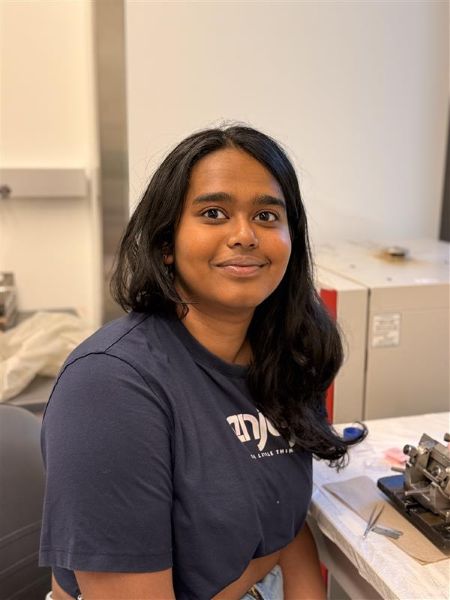
Through this dual perspective of being both mentored and mentoring, Elissa has come to see how knowledge is passed on and reshaped within a research community. It’s not just about individual achievement, but about creating an environment where people feel supported to explore, question, and contribute.
Community, Reflection, and Looking Ahead
Beyond her research, Elissa has found a strong sense of community within her department and among her peers. From daily interactions in the lab to connections across the Life Sciences building, those relationships have shaped her experience in meaningful ways. Whether it’s troubleshooting experiments together, sharing ideas, or simply navigating the ups and downs of graduate school, that sense of shared experience has been an important part of her journey.
“When I think of UW, I think of the community that I have through my cohort and department.”
As she reflects on her time at UW, Elissa expresses appreciation for both the academic opportunities and the people who have supported her along the way. Looking ahead, she sees a future that continues to build on both research and teaching. “I love so many aspects of what I’m doing. It’s something I want to do long-term. UW has opened up that door for me,” she shared.
For Elissa, her time at UW has been defined not only by the research she’s conducted, but by the community she’s found and the relationships she’s built, an experience that will continue to shape her path forward.
Learn about Elissa's unique research with saline mosquitoes.